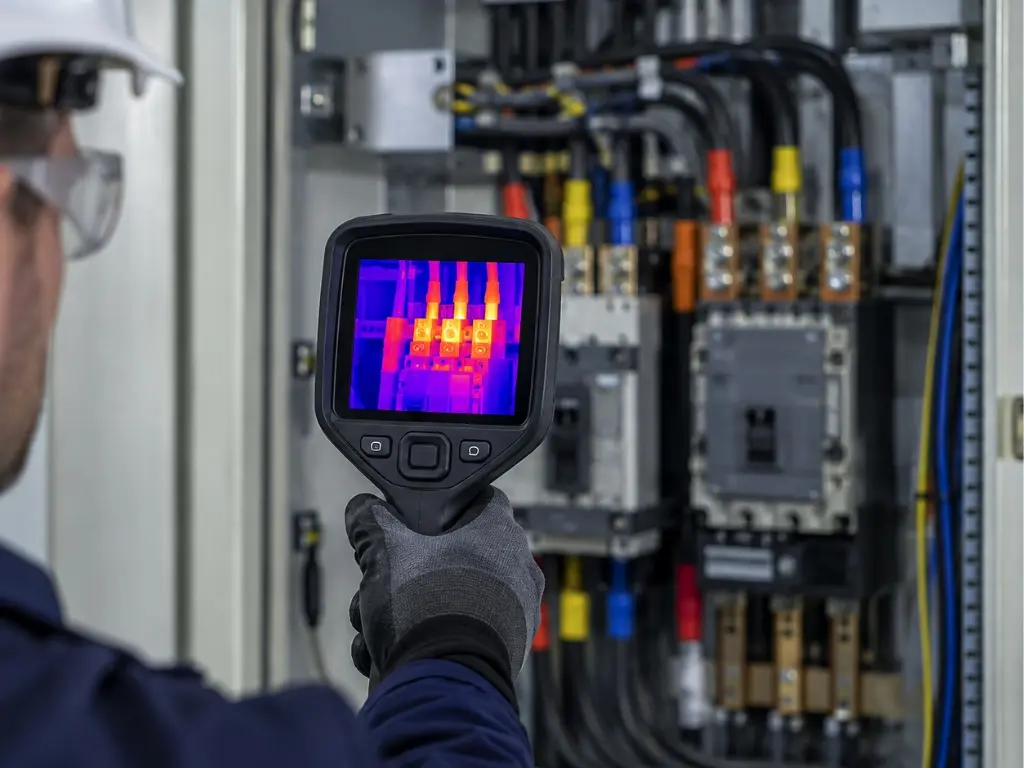
When an electrician points a thermal camera at an electrical panel, the resulting image can look dramatically different from what you see with your eyes. Bright reds, oranges, yellows, blues, and purples may appear across breakers, wires, and connections. But what do those colors actually mean? Does red automatically signal an electrical problem?
During a commercial thermal imaging service, colors make temperature differences easier to visualize. However, understanding those colors requires more than assuming red means danger and blue means safe. The palette, temperature scale, equipment load, and surrounding conditions all influence what appears on the screen.
What Does a Commercial Thermal Imaging Service Measure?
Thermal cameras detect infrared energy emitted by surfaces and convert that information into a visible image. Different temperatures are then represented by colors or shades, allowing technicians to identify unusual heat patterns that would otherwise be invisible.
In commercial settings, thermal imaging may be used to examine electrical panels, breakers, connections, switchgear, transformers, motor control centers, and other equipment.
NASA includes infrared thermography in its facilities maintenance guidance and describes applications involving energized electrical equipment such as transformers, switchgear, substations, and motor control centers. This makes thermal imaging useful as part of a broader preventive maintenance strategy.
What are the Thermal Colors?
Thermal colors make differences in surface temperature easier to see, but they do not have universal meanings. For the examples below, we’ll use the Iron/Ironbow palette, where colors generally progress from dark shades for cooler areas to bright shades for warmer areas.
Black and Dark Purple: Cooler Areas
Black and dark purple generally represent the coolest surfaces within the temperature range displayed on the thermal image. These colors may appear on equipment that is not carrying much load, surrounding surfaces that naturally remain cooler, or components operating at lower temperatures than nearby equipment.
However, a dark-colored component should not automatically be considered safe or problem-free. Thermal imaging relies heavily on comparison and context. For example, a component that appears dark because it is not carrying the expected electrical load could potentially warrant investigation. Technicians therefore consider the equipment’s function, operating conditions, and actual temperature rather than treating darker colors as a universal sign of normal operation.
Purple and Blue: Lower Temperatures
Purple and blue typically represent lower-to-moderate temperatures in an Iron/Ironbow thermal image. They often form transitional areas between the coolest black or dark-purple portions and progressively warmer red, orange, and yellow areas.
These colors can be useful for recognizing how heat is distributed across a piece of equipment. A gradual transition from cooler to warmer colors may be expected in some situations, while an unusual temperature pattern between comparable components can attract attention. For example, technicians may compare similar breakers, connections, or electrical phases operating under comparable conditions to determine whether one is behaving differently from the others.
Again, blue or purple does not automatically mean “safe.” The temperature scale and operating conditions must be considered.
Red: Warmer Areas
Red is one of the colors most likely to catch a property owner’s attention because it is commonly associated with heat and danger. In an Iron/Ironbow palette, however, red simply means that a surface is relatively warmer than areas represented by darker colors.
During a commercial thermal imaging service, a technician may pay closer attention to a red area when it appears unexpectedly. For instance, if one connection appears red while similar connections under comparable loads appear purple, the temperature difference could justify further evaluation.
Still, red does not automatically indicate overheating, an electrical fault, or an immediate hazard. A properly functioning component can naturally operate at a higher temperature than surrounding equipment. Technicians consider the measured temperature, electrical load, equipment specifications, and temperature differences before determining whether additional investigation is necessary.
Orange and Yellow: Higher Temperatures
Orange and yellow generally indicate surfaces approaching the higher end of the temperature range displayed in the image. These brighter colors make warmer areas particularly easy to identify during an inspection.
An isolated orange or yellow area may receive additional attention if comparable components appear significantly cooler. For example, a warmer electrical connection could potentially be associated with increased resistance, while a warmer conductor might require consideration of its electrical load. The thermal image helps identify where closer inspection or testing may be appropriate; it does not establish the underlying cause on its own.
Technicians may also look at the shape and distribution of the warmer area. A concentrated hot spot can provide different information from heat that is distributed evenly across an entire component.
White: Hottest Areas
In an Iron/Ironbow-style palette, white generally represents the hottest portion of the temperature range currently displayed. Because it creates strong visual contrast, a small white area surrounded by darker colors can immediately stand out.
However, “hottest in the image” and “dangerously hot” are not the same thing. If a thermal image covers a relatively narrow or low temperature range, the warmest object can still appear white even when its actual temperature is not excessive.
For this reason, technicians do not diagnose a problem simply because a component appears white. They check the temperature scale and measured temperature and may compare the component with similar equipment under similar operating conditions. If the temperature is unusually high for that component or substantially different from comparable equipment, further electrical evaluation may be appropriate.
Isotherm Colors: Highlighting a Selected Temperature Range
Isotherms differ from the normal progression of colors in a thermal palette. Instead of simply assigning colors across the entire temperature range, an isotherm allows a selected temperature or temperature range to be highlighted with a particular color.
For example, a technician can configure the camera so surfaces meeting a selected temperature criterion stand out from the rest of the image. This can make it easier to locate and compare areas that fall within, above, or below a temperature range of interest, depending on the camera and settings being used.
The important distinction is that an isotherm color is intentionally assigned according to selected temperature criteria. It should therefore be interpreted according to those settings rather than according to the usual meaning of red, yellow, blue, or another color in the underlying palette.
Important Note:
These descriptions apply generally to an Iron/Ironbow-style palette and should not be treated as universal color codes. Thermal cameras can use different palettes and temperature scales, so a professional thermal imaging service considers actual temperature measurements, equipment conditions, and temperature differences rather than judging a component by color alone.
Why Doesn’t Red Always Mean Danger?
A bright red area certainly attracts attention, but it does not automatically mean a component is overheating.
Thermal cameras can distribute colors according to the temperature range present in a particular scene. As a result, an object may appear red simply because it is warmer than everything around it. Change the scale or palette, and that same temperature could appear as another color.
The more important question is whether the component’s temperature is abnormal for its operating conditions.
Technicians may compare similar breakers, connections, electrical phases, or pieces of equipment under comparable loads. A significant temperature difference between otherwise similar components may provide a reason for further investigation.
What Can Abnormal Heat Patterns Reveal?
One of the biggest benefits of a commercial thermal imaging service is the ability to locate unusual temperature patterns before a problem becomes obvious through visible damage or equipment failure.
The U.S. Department of Energy notes that loose or corroded electrical connections can produce abnormally high temperatures because of increased electrical resistance. Infrared imaging can help identify these conditions so they can be investigated before equipment failure or a potential fire occurs.
Depending on the equipment and operating conditions, unusual heat patterns may be associated with loose connections, excessive resistance, overloaded components, load imbalances, or deteriorating equipment.
NASA even establishes a predictive-maintenance benchmark of 3% or fewer faults among devices surveyed using infrared thermography, demonstrating how thermographic findings can be formally tracked within facility maintenance programs.
Still, a thermal anomaly is a finding, not necessarily a complete diagnosis. Additional electrical testing may be required to determine its cause.
Can Thermal Images Be Misleading?
Yes, particularly when they are interpreted without enough context.
Reflective materials, viewing angle, equipment load, ambient temperature, emissivity, distance, and camera settings can all influence thermal measurements. Shiny metal surfaces can be especially challenging because they may reflect infrared energy from nearby objects.
This is why simply purchasing a thermal camera does not replace professional interpretation. A trained technician considers the image together with actual temperature measurements, operating conditions, comparable components, equipment history, and other electrical findings.
How Much Does It Cost to Get Thermal Imaging Done?
A commercial thermal imaging service typically costs around $300 to $2,000 or more, depending on the property and inspection scope. Smaller facilities may fall near the lower end, while larger or more complex electrical systems can cost more.
Pricing depends on factors such as the number of panels and components inspected, accessibility, inspection time, and reporting requirements. For an accurate price, request a property-specific estimate.
Look Beyond the Red, Yellow, and Blue
Thermal colors help visualize temperature differences, but they are not universal warning codes. The real value of a thermal imaging service comes from professional interpretation of unusual heat patterns.
KSB Electric provides professional thermal imaging services to help identify unusual heat patterns in commercial electrical systems. Contact KSB Electric today to schedule a thermal imaging service and stay ahead of potential electrical concerns.